
The n8n vs Zapier question comes up in almost every sales automation project I take on. I build sales automation on both n8n and Zapier. My no-show recovery system for a SaaS client was built entirely in Zapier and later featured on the Zapier blog. These days most of my new builds, including my own lead inbox, run on self-hosted n8n. So this isn’t a comparison from a vendor with a side to pick.
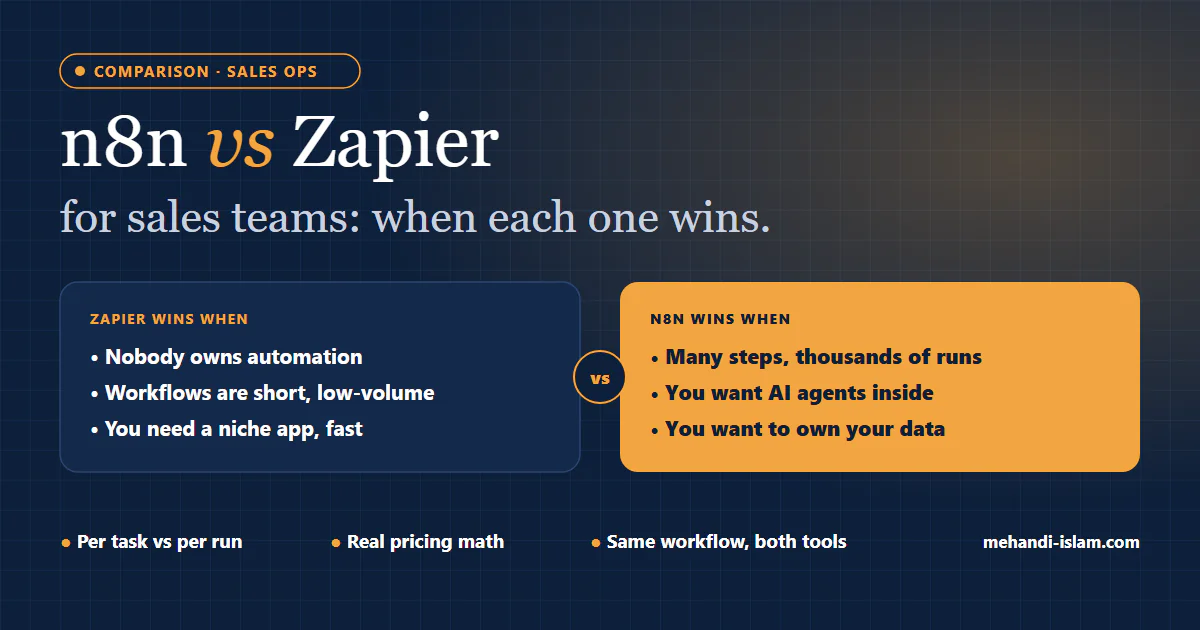
The short answer: pick Zapier if nobody on your team owns automation and your workflows are short and low-volume. Pick n8n if your workflows have many steps or run thousands of times a month, if you want AI agents in them, or if you want to own your data and have someone to look after it.
The rest of this n8n vs Zapier comparison explains why, with the pricing worked out and a real sales workflow built in both.
n8n vs Zapier at a glance
| Zapier | n8n | |
|---|---|---|
| Hosting | Cloud only, fully managed | n8n Cloud, or self-hosted on your own server |
| How you’re billed | Per task: every successful action step | Per execution: one full workflow run, however many steps |
| Entry paid plan | Professional: $19.99/mo billed annually (750 tasks) | Starter: €20/mo billed annually (2,500 executions) |
| Integrations | 9,000+ apps | Fewer native nodes, plus an HTTP Request node for any API |
| Learning curve | Low. Built for non-technical users | Medium. You’ll meet JSON, expressions and webhooks |
| Complex logic | Paths and Filters; gets awkward when branches multiply | Built for branching, loops and data transformation |
| AI | AI steps and agent features | AI agent nodes with your choice of model |
| Data control | Your data runs through Zapier’s cloud | Self-hosted keeps it on your own server |
| Who maintains it | Zapier | n8n Cloud: n8n. Self-hosted: you |
Prices checked on 12 November 2026 on zapier.com/pricing and n8n.io/pricing. Both change, so check before you buy.
n8n vs Zapier pricing: how each one bills you
Plan prices look similar at the entry level. The difference is what you’re paying for.
Zapier counts tasks. According to Zapier’s help centre, a task is any successful action. The trigger doesn’t count, and neither do filters, paths or failed steps. But every action step that runs does. A Zap with five action steps uses five tasks every time it runs. (Zapier says that from 1 December 2026, its newer Zap types will use tasks too, so check the current rules for the Zap type you use.)
n8n counts executions. n8n’s pricing page defines an execution as a single run of your entire workflow, no matter how many steps it has. A workflow with five steps or fifty uses one execution per run.
Here’s what the n8n vs Zapier difference means for a sales workflow that runs 1,000 times a month. This is an illustrative calculation, not a client’s bill:
| Workflow | Zapier usage | n8n usage |
|---|---|---|
| Trigger + 1 action (e.g. form → CRM) | 1,000 tasks | 1,000 executions |
| Trigger + 5 actions (e.g. form → enrich → CRM → assign → email → Slack) | 5,000 tasks | 1,000 executions |
| Trigger + 11 actions (a full routing and follow-up flow) | 11,000 tasks | 1,000 executions |
The one-step workflow costs about the same on both. The five-action workflow already uses more than six times the tasks included in Zapier’s entry Professional plan, so you’d need a higher task tier. On n8n, all three fit inside the 2,500 executions of the Starter plan.
And self-hosted n8n? n8n publishes a self-hosted Community Edition on GitHub, so there’s no per-execution bill at all. The cost moves elsewhere: a server (usually a small VPS), plus someone’s time for updates, backups and monitoring. If nobody on your team can do that, factor in paying someone who can.
Where Zapier wins for sales teams
Speed and simplicity. A sales manager can connect Calendly to a CRM and a Slack channel in an afternoon, with no technical help. For a team without an ops person, that matters more than any pricing table.
The app catalogue. Zapier lists 9,000+ apps, and most sales tools have ready-made triggers and actions, including niche ones. When a native integration exists, you skip the API docs entirely.
Light internal tools. Zapier Tables and Interfaces let you store records and build simple forms without another tool.
The no-show recovery system I built was a good fit: Calendly events flow through Zapier into a Zapier Table, update GoHighLevel, trigger email and SMS follow-ups, and alert the team in Slack. No custom code, and the client’s team could maintain it after handover. Three months later revenue was up 60%. The full case study has the details.
Where Zapier starts to hurt: cost climbs with every step and every run, and workflows with many branches get hard to read and debug.
Where n8n wins for sales teams
Cost at volume. Because you pay per run, not per step, long workflows that run often are much cheaper. Self-hosting removes the per-run bill entirely.
Logic and data handling. Routing a lead by territory, deal size and source, merging records from two systems or cleaning messy form data is all easier in n8n. When a ready-made node doesn’t exist, the HTTP Request node talks to any API. HubSpot, Salesforce, Pipedrive and Zoho CRM all have native nodes.
AI agents. n8n has agent nodes where you choose the model, give it tools and keep the prompt in your own workflow.
Here’s a real example. My own AI lead qualification agent runs on self-hosted n8n. Every new message from a freelance marketplace is parsed and checked against that contact’s history. An AI model then classifies it (new lead, active client, at risk, small talk or spam), scores it from 1 to 10 and drafts a reply. Only the messages that matter trigger an instant email to me. Everything else goes into a 9 AM digest that also lists anyone at risk or gone quiet for two days. That’s a dozen-plus steps per message, which would burn through Zapier tasks quickly. On my own server it costs nothing per run.
Data ownership. On a self-hosted instance, your leads and messages stay on a server you control. For some clients that’s the deciding factor.
Where n8n hurts: the learning curve is real. You’ll deal with JSON, expressions and webhook payloads. And a self-hosted instance needs an owner: if it goes down at 2 AM, nobody at n8n is going to fix it for you.
The same sales workflow in both tools
Here’s the no-show recovery system from the case study, step by step, in each tool:
| Step | Zapier | n8n |
|---|---|---|
| 1. Capture booking events | Calendly trigger (booked, canceled, no-show) | Calendly trigger node, or a webhook |
| 2. Log every event | Zapier Tables | An n8n data table, Google Sheet or database |
| 3. Update the CRM | GoHighLevel action | An HTTP Request to GoHighLevel’s API |
| 4. Follow up by status | Paths: canceled → rebook email, no-show → recovery sequence | A Switch node with one branch per status |
| 5. Alert the team | Slack action, filtered to high-priority leads | Slack node behind an IF node |
The logic is identical. What changes is how you build it and what you pay. In Zapier, each run uses a task for every action that fires on its path. In n8n, each run is one execution. For a team booking a few dozen calls a month, Zapier is simpler and the cost difference is small. For a team handling thousands of booking events, n8n is worth the extra setup.
n8n vs Zapier: which should you pick? A 5-question checklist
- Does anyone on your team own automations and understand webhooks and JSON? If not, start with Zapier, or with n8n Cloud and outside help.
- How many steps do your main workflows have, and how often do they run? Multiply them. If the task count is well past Zapier’s plan limits, n8n will usually cost less.
- Do you need AI agents or LLM steps inside the workflow? n8n gives you more control over models, prompts and tools.
- Do you have privacy or data-ownership requirements? Self-hosted n8n keeps the data on your own server.
- Are your key apps native in both? If a tool you depend on only has a Zapier integration and no public API, that settles it.
My usual recommendation by team type:
- Small team, no ops person, a handful of simple workflows: Zapier.
- Growing team with rising Zapier bills and someone who owns ops: move the expensive workflows to n8n, Cloud or self-hosted.
- Teams that want to save money or own their data, and have (or hire) someone technical: self-hosted n8n. It’s also a cheap way to test n8n before committing.
I’ve moved clients from Zapier to self-hosted n8n, and it came down to the same two reasons each time: pricing as their volume grew, and wanting to own their data.
Can you use both?
Yes, and it’s often the sensible path. Keep the simple Zaps that work, and move the high-volume or AI-heavy workflows to n8n first. Just keep each piece of logic in one place: if a lead’s status can be changed by both a Zap and an n8n workflow, nobody will know which one did it when something breaks. I make the same point in my Zoho CRM automation guide.
FAQ
Is n8n really free?
The self-hosted Community Edition is published on GitHub and has no per-execution bill. You still pay for the server and for someone’s time to maintain it. n8n Cloud plans are paid, starting at €20 a month billed annually for 2,500 executions (checked 12 November 2026).
Is n8n harder to use than Zapier?
Yes, for non-technical users. Zapier is built so anyone can connect two apps. n8n is visual too, but sooner or later you’ll work with JSON data, expressions and API responses.
Can n8n connect to my CRM?
HubSpot, Salesforce, Pipedrive and Zoho CRM have native n8n nodes. For a CRM without one, the HTTP Request node can call its API directly, as long as the CRM has a public API.
Should I migrate from Zapier to n8n?
Only when the numbers or the requirements justify it: your task bill keeps climbing, your workflows have outgrown Paths, or you need to own your data. Migrate the most expensive workflows first and leave the simple ones alone.
Is n8n better for AI agents?
For custom agent workflows, usually yes: you choose the model, the tools and the prompt, and it all lives in your workflow. Zapier also has AI features, and they’re easier to start with.
Not sure which fits your stack?
I’ll look at your current workflows, what they cost and where leads slip through, and tell you whether Zapier, n8n or both make sense. The 30-minute Revenue Leak Audit is free.